Website vs Web Application: Key Differences, Business Use Cases & How to Choose the Right Solution

Author: Siva Prakash
In today's digital-first business environment, having an online presence is no longer optional. Whether you're a startup founder, business owner, marketing leader, or enterprise decision-maker, your digital platform often becomes the first touchpoint between your brand and potential customers. However, one of the most common questions businesses face during digital transformation initiatives is: "Do we need a website or a web application?"
While these terms are often used interchangeably, they serve very different purposes. Choosing the wrong solution can result in wasted budgets, delayed launches, poor user experiences, scalability issues, and missed business opportunities.
At Digital Asan, we regularly work with businesses that are unsure whether they need a traditional website, a custom web application, or a combination of both. Through our experience in website development, digital transformation consulting, UX optimization, SEO, conversion rate optimization (CRO), and growth marketing, we've seen firsthand how the right digital foundation can accelerate business growth.
This comprehensive guide will help you understand the difference between a website and a web application, explore real-world use cases, and learn how to make the right decision for your business goals.
Understanding the Modern Digital Landscape
The digital ecosystem has evolved dramatically over the past decade. Businesses are no longer building online platforms solely for visibility. Today, digital experiences are expected to attract visitors, generate leads, automate operations, improve customer experiences, and drive revenue.
As technology advances, organizations typically invest in one of two primary digital solutions:
- Websites
- Web Applications
Although they may look similar on the surface, their purpose, functionality, architecture, and business impact are significantly different. Understanding these differences is critical before investing in development.
What Is a Website?
A website is a collection of publicly accessible web pages connected under a single domain. Its primary purpose is to provide information, promote products or services, build brand awareness, and generate business inquiries. Most websites are designed to help users consume content rather than perform complex tasks.
Examples of websites include:
- Corporate Websites
- Business Websites
- Portfolio Websites
- Marketing Websites
- News Websites
- Educational Websites
- Blog Platforms
- Non-Profit Organization Websites
A visitor typically browses pages, reads information, submits contact forms, downloads resources, or makes inquiries through a website.
Common Features of a Website
- Home Page
- About Us Page
- Services Pages
- Product Pages
- Contact Forms
- Blog Content
- Landing Pages
- Case Studies
- SEO Optimization
- Lead Generation Forms
For many businesses, a website acts as a digital storefront that supports marketing and sales efforts.
What Is a Web Application?
A web application is an interactive software platform that users access through a web browser. Unlike a website, a web application allows users to perform actions, manage data, automate workflows, and interact with business systems. Web applications focus on functionality rather than content consumption.
Examples of web applications include:
- Customer Portals
- Learning Management Systems (LMS)
- CRM Platforms
- Project Management Tools
- Online Booking Systems
- Healthcare Portals
- Banking Platforms
- SaaS Products
- Employee Management Systems
- Inventory Management Solutions
Users typically log in, access personalized dashboards, manage information, and complete tasks within a web application.
Common Features of a Web Application
- User Authentication
- Role-Based Access Control
- Custom Dashboards
- Database Connectivity
- Workflow Automation
- Real-Time Data Processing
- API Integrations
- Notifications
- Reporting & Analytics
- Personalized User Experiences
Web applications often become essential operational tools for businesses and their customers.
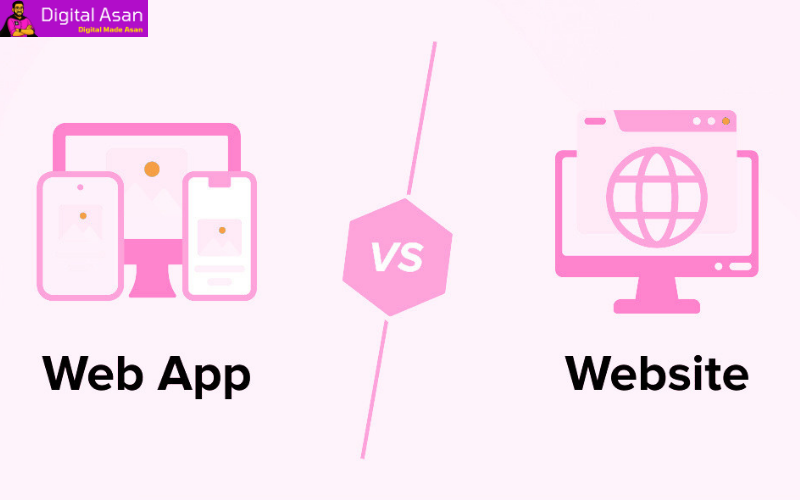
Website vs Web Application: Key Differences Explained
At a high level, the main difference is simple:
- A website is primarily designed to inform.
- A web application is primarily designed to perform.
Let's look at a detailed comparison.
| Factor | Website | Web Application |
|---|---|---|
| Purpose | Provide Information | Enable Functionality |
| User Interaction | Limited | High |
| Login Requirement | Usually Optional | Typically Required |
| Database Usage | Minimal | Extensive |
| Personalization | Basic | Advanced |
| SEO Importance | Very High | Moderate |
| Development Complexity | Lower | Higher |
| Maintenance Effort | Lower | Higher |
| Business Automation | Limited | Extensive |
| Development Cost | Lower | Higher |
Did You Know? Many Successful Businesses Use Both
One of the biggest misconceptions is that businesses must choose between a website and a web application. In reality, many successful organizations use both together.
For example:
- The website attracts visitors through SEO and digital marketing.
- The web application delivers services to registered users.
Examples include:
- HubSpot
- Salesforce
- Shopify
- Coursera
- Canva
- Zoom
Each company has a public-facing website for marketing and a separate web application that powers its core service.
When Should You Build a Website?
A website is often the best option when your primary goal is visibility, awareness, lead generation, and content marketing.
You Need a Website If:
- You want to establish an online presence.
- You need to rank on Google.
- You want to generate leads.
- You need content marketing capabilities.
- You want to showcase products or services.
- You run digital advertising campaigns.
- You need landing pages.
- You want to build brand credibility.
For many businesses, a high-performing website can generate substantial results before a web application becomes necessary.
When Should You Build a Web Application?
A web application becomes necessary when users need to perform tasks rather than simply consume information.
You Need a Web Application If:
- Users need secure accounts.
- You manage customer data.
- You automate business processes.
- You provide online services.
- You offer subscription-based products.
- You need custom workflows.
- You require advanced integrations.
- You provide software as a service (SaaS).
In these scenarios, a traditional website alone cannot adequately support business operations.
Why Businesses Often Choose the Wrong Solution
Many organizations make technology decisions based on trends rather than business requirements.
Common mistakes include:
- Building a web application when a website would achieve the goal.
- Creating a website when operational needs require a web application.
- Ignoring future scalability requirements.
- Prioritizing features over business outcomes.
- Making decisions without user research.
These mistakes often lead to increased costs, technical debt, and the need for expensive redevelopment projects.
Why Business Goals Should Drive Technology Decisions
At Digital Asan, we believe technology should support business objectives—not the other way around. Before recommending a website or web application, we evaluate:
- Business Goals
- User Needs
- Customer Journey Requirements
- SEO Objectives
- Growth Plans
- Operational Workflows
- Integration Requirements
- Future Scalability Needs
This strategic approach helps businesses invest in solutions that drive measurable outcomes rather than simply adding complexity.
Website vs Web Application Cost Comparison: Which Is More Expensive?
One of the first questions businesses ask when planning a digital project is, "How much will it cost?" While there is no universal answer, web applications typically require a larger investment than websites due to their complexity, integrations, security requirements, and custom functionality. However, cost should never be the only deciding factor. The real question should be: "Which solution delivers the best business value and ROI?"
| Factor | Website | Web Application |
|---|---|---|
| Initial Development Cost | Lower | Higher |
| Design Complexity | Moderate | High |
| Backend Development | Minimal | Extensive |
| Database Requirements | Basic | Advanced |
| Security Requirements | Standard | Advanced |
| Maintenance Cost | Lower | Higher |
| Scalability Investment | Moderate | High |
Businesses should evaluate both short-term costs and long-term value before making a decision.
Which Is Better for SEO: Website or Web Application?
Search Engine Optimization (SEO) is one of the most important considerations when deciding between a website and a web application. Traditional websites are generally more SEO-friendly because they are designed to publish content, target keywords, and attract organic traffic from search engines. Web applications, on the other hand, focus on functionality rather than discoverability.
Why Websites Excel at SEO
- Search Engine Friendly Architecture
- Optimized Page Structures
- Content Marketing Opportunities
- Blog Publishing Capabilities
- Landing Pages for Target Keywords
- Internal Linking Structures
- Schema Markup Implementation
- Technical SEO Optimization
This is why businesses investing in lead generation often start with a website before expanding into web applications.
Can Web Applications Be SEO Optimized?
Yes, but it often requires additional planning. Modern web applications can support SEO through:
- Server-Side Rendering (SSR)
- Dynamic Rendering
- Technical SEO Best Practices
- Optimized URL Structures
- Fast Page Load Times
- Structured Data
However, if your primary objective is attracting organic search traffic, a website remains the stronger foundation.
Did You Know? SEO Often Pays for the Website Before It Pays for the Business
Many companies underestimate the long-term value of organic search. A well-optimized website can:
- Generate Leads 24/7
- Reduce Paid Advertising Costs
- Improve Brand Authority
- Increase Customer Trust
- Create Sustainable Growth
This is why Digital Asan places a strong emphasis on SEO-first website architecture during the planning stage.
How User Experience (UX) Differs Between Websites and Web Applications
User experience requirements differ significantly depending on the type of platform.
Website UX Goals
- Easy Navigation
- Fast Information Discovery
- Lead Generation
- Content Consumption
- Brand Communication
Web Application UX Goals
- Task Completion
- Workflow Efficiency
- Data Management
- User Productivity
- Feature Accessibility
While websites focus on helping visitors find information, web applications focus on helping users accomplish tasks.
Website vs Web Application: Which Provides Better Business Value?
The answer depends entirely on your business objectives.
| Business Goal | Recommended Solution |
|---|---|
| Lead Generation | Website |
| Content Marketing | Website |
| SEO Growth | Website |
| Brand Awareness | Website |
| Customer Portal | Web Application |
| Workflow Automation | Web Application |
| SaaS Product | Web Application |
| Online Learning Platform | Web Application |
| Booking System | Web Application |
The key is matching technology capabilities with business requirements.
Step-by-Step Process: How to Decide Between a Website and a Web Application
Step 1: Define Your Business Goals
Start by identifying what you want your platform to achieve.
- Generate Leads?
- Increase Sales?
- Automate Processes?
- Improve Customer Experience?
- Launch a Digital Product?
Step 2: Understand Your Users
Identify who will use the platform and what they need to accomplish.
- Customers
- Employees
- Partners
- Students
- Members
Step 3: Map User Journeys
Determine how users interact with your business. If they primarily consume information, a website may be sufficient. If they perform tasks, a web application may be required.
Step 4: Evaluate Scalability Requirements
Consider your future growth plans.
- Expected Traffic Growth
- User Growth
- Feature Expansion
- Automation Opportunities
- Integration Requirements
Step 5: Build the Right Foundation
Choose the solution that aligns with both current and future business needs.
Common Mistakes Businesses Make
Over the years, we've seen organizations make several avoidable mistakes.
- Choosing technology before defining objectives.
- Prioritizing features over business outcomes.
- Ignoring SEO during development.
- Underestimating scalability needs.
- Skipping user research.
- Building complex systems too early.
- Failing to align marketing and technology strategies.
These mistakes often result in increased costs, delayed launches, and poor user experiences.
How Digital Asan Approaches Digital Strategy
At Digital Asan, we help organizations avoid costly technology mistakes by taking a business-first approach. Rather than immediately recommending a website or web application, we start by understanding:
- Business Objectives
- Customer Journeys
- Marketing Goals
- SEO Opportunities
- Operational Workflows
- Growth Plans
- Technology Constraints
This approach ensures that every digital investment contributes directly to measurable business outcomes.
Related Resources You May Find Helpful
- Website Audit Services
- Website Optimization Guide
- Growth Marketing vs Traditional Marketing
- Go-To-Market Strategy Framework
- SEO Optimization Services
These resources provide additional insights into how businesses can improve digital performance, increase conversions, and accelerate growth.
Why Choose Digital Asan for Website and Web Application Development?
Choosing between a website and a web application is only the first step. The real challenge lies in planning, designing, developing, optimizing, and continuously improving the digital experience to support business growth. At Digital Asan, we help organizations move beyond simply building digital platforms. Our focus is on creating business-driven digital experiences that generate measurable outcomes.
Whether you're launching a new business website, developing a customer portal, building a SaaS platform, or modernizing an existing digital ecosystem, our approach combines strategy, user experience, technology, SEO, CRO, and growth marketing into a unified framework.
What Makes Digital Asan Different?
- Business-First Approach
- SEO-Driven Development Strategy
- Conversion-Focused User Experience
- Scalable Technology Architecture
- Data-Driven Decision Making
- Growth Marketing Expertise
- Digital Transformation Consulting
- Continuous Optimization Mindset
Rather than focusing solely on development, we focus on helping businesses achieve growth objectives through digital experiences.
How We Do It: The Digital Asan Framework
Our process is designed to minimize risk while maximizing business outcomes.
Step 1: Business Discovery & Goal Alignment
We start by understanding:
- Business Objectives
- Target Audience
- Growth Plans
- Operational Challenges
- Customer Expectations
- Competitive Landscape
This phase helps us determine whether a website, web application, or hybrid solution is the right fit.
Step 2: User Experience Research
User experience plays a critical role in digital success.
We analyze:
- User Behavior
- Customer Journeys
- Pain Points
- Conversion Paths
- Engagement Opportunities
- Usability Requirements
The goal is to design experiences that users actually want to engage with.
Step 3: SEO & Digital Visibility Planning
Many development projects overlook SEO until after launch.
At Digital Asan, SEO is integrated from day one.
Our planning includes:
- Keyword Research
- Information Architecture
- Content Planning
- Internal Linking Strategy
- Technical SEO Requirements
- Schema Opportunities
- Search Intent Mapping
This ensures your platform is built for discoverability as well as functionality.
Step 4: UX Design & Wireframing
Before development begins, we create user-centric experiences through:
- Wireframes
- User Flows
- Interaction Models
- Conversion-Focused Layouts
- Mobile-First Design Principles
Every design decision is aligned with business objectives and user needs.
Step 5: Development & Quality Assurance
Once strategy and design are approved, development begins.
Our development process includes:
- Front-End Development
- Back-End Development
- Database Architecture
- API Integrations
- Security Reviews
- Performance Optimization
- Quality Assurance Testing
We prioritize scalability, maintainability, and performance at every stage.
Step 6: Launch, Optimization & Growth
Launch is not the finish line.
After deployment, we continue improving performance through:
- SEO Optimization
- Conversion Rate Optimization (CRO)
- Analytics Monitoring
- A/B Testing
- User Experience Enhancements
- Growth Marketing Initiatives
This continuous improvement approach helps maximize ROI over time.
Website vs Web Application: Decision Checklist
If you're still unsure which solution is right for your business, use the following checklist.
| Requirement | Website | Web Application |
|---|---|---|
| Need SEO Traffic | ✓ | |
| Need Lead Generation | ✓ | |
| Need Content Marketing | ✓ | |
| User Login Required | ✓ | |
| Workflow Automation | ✓ | |
| Customer Dashboard | ✓ | |
| SaaS Product | ✓ | |
| Marketing Campaign Support | ✓ | |
| Business Operations Management | ✓ |
The Future of Websites and Web Applications
The distinction between websites and web applications is becoming increasingly blurred.
Modern digital experiences are evolving through:
- Artificial Intelligence (AI)
- Generative AI Interfaces
- Progressive Web Applications (PWAs)
- Personalized Experiences
- Predictive Analytics
- Automation Platforms
- Customer Data Platforms
- Voice Interfaces
- Headless Architectures
Businesses must now think beyond simply "having a website" and instead focus on creating connected digital ecosystems.
AI-Powered Experiences: The Next Evolution
Artificial Intelligence is transforming both websites and web applications.
Organizations are increasingly implementing:
- AI Chatbots
- Personalized Content Recommendations
- Predictive Search
- Automated Customer Support
- Behavior-Based Personalization
- AI-Powered Analytics
- Content Generation Workflows
The organizations that successfully integrate AI into their digital experiences will gain significant competitive advantages in the coming years.
Final Thoughts: Website vs Web Application
The debate between a website and a web application is not about which one is better. The real question is: "Which solution best supports your business goals?"
A website is typically the right choice when your primary objectives involve visibility, SEO, lead generation, content marketing, and brand building. A web application is often the better solution when you need user authentication, workflow automation, customer portals, operational efficiencies, or software functionality. Many successful organizations ultimately use both, creating a website to attract and educate users while leveraging a web application to deliver services and manage customer interactions. The key is making a strategic decision based on business outcomes rather than technology trends.
Ready to Build the Right Digital Foundation?
At Digital Asan, we help businesses evaluate, plan, design, develop, optimize, and scale digital experiences that drive measurable results. Whether you're considering a new website, custom web application, digital transformation initiative, SEO strategy, website audit, UX optimization project, or growth marketing engagement, our team can help you identify the right path forward.
Because the most successful digital projects don't start with technology. They start with a strategy.