eCommerce Website SEO: How to Rank Product Pages and Categories on Google

Author: Siva Prakash
The eCommerce industry has transformed the way businesses sell products and connect with customers. Whether you're running a Shopify store, WooCommerce website, Magento platform, BigCommerce store, or a custom-built eCommerce website, one challenge remains constant: getting your products discovered online. While paid advertising can generate immediate traffic, long-term growth often depends on your ability to attract qualified visitors organically through search engines.
This is where eCommerce Website SEO becomes one of the most valuable investments for online businesses.
Every day, millions of users search for products on Google using keywords such as "best wireless headphones," "running shoes for men," "organic skincare products," and thousands of other commercial search queries. Businesses that rank on the first page of Google often receive a significant share of this traffic, while those buried on later pages struggle to compete.
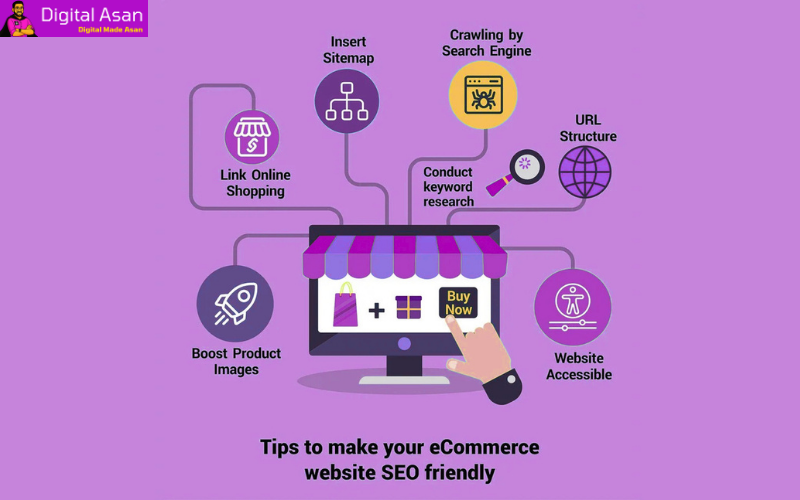
At Digital Asan, we've worked with organizations across industries to improve website visibility, enhance user experiences, optimize conversion paths, and build scalable SEO strategies that drive measurable business outcomes. Through website audits, SEO consulting, growth marketing initiatives, website optimization projects, and digital experience transformation programs, we've seen how strategic eCommerce SEO can become a powerful growth engine. In this comprehensive guide, you'll learn how to rank product pages and category pages on Google, improve search visibility, and create an SEO framework that supports sustainable eCommerce growth.
Why Is eCommerce Website SEO More Important Than Ever?
The online shopping landscape is more competitive than ever before. Thousands of eCommerce websites compete for the same customers, products, and search terms. At the same time, customer acquisition costs continue to rise through paid advertising channels.
Businesses that rely entirely on paid traffic often face challenges such as:
- Increasing advertising costs.
- Lower profit margins.
- Unpredictable traffic fluctuations.
Organic search traffic offers a more sustainable alternative. When your product pages and category pages rank well on Google, they can continuously attract qualified visitors without requiring payment for every click. This creates compounding value over time.
What Is eCommerce Website SEO?
eCommerce Website SEO is the process of optimizing an online store to improve its visibility in search engine results pages (SERPs). The goal is to help search engines understand your products, categories, and website structure while providing users with relevant information that satisfies their search intent.
Unlike traditional website SEO, eCommerce SEO requires optimization across multiple content types, including:
- Product Pages
- Category Pages
- Collection Pages
- Buying Guides
- Blog Content
- Internal Search Pages
- Technical Website Architecture
A successful eCommerce SEO strategy combines technical SEO, content optimization, user experience improvements, internal linking, and conversion optimization.
Did You Know? Most Product Pages Never Rank Well on Google
Many eCommerce businesses assume that simply publishing product pages will automatically generate search traffic.
Unfortunately, this rarely happens.
One of the biggest challenges in eCommerce SEO is that many product pages contain:
- Thin content.
- Manufacturer-provided descriptions.
- Duplicate information.
- Limited contextual relevance.
As a result, search engines often struggle to differentiate one product page from another. The businesses that succeed in eCommerce SEO go beyond basic product information and create richer, more helpful experiences for users.
Understanding the Difference Between Product Pages and Category Pages
One of the most overlooked aspects of eCommerce SEO is understanding the unique role of product pages and category pages.
| Page Type | Primary Purpose | SEO Goal |
|---|---|---|
| Product Page | Sell a specific product | Rank for transactional keywords |
| Category Page | Organize related products | Rank for broader commercial keywords |
| Collection Page | Group similar products | Improve discoverability |
| Buying Guide | Educate shoppers | Rank for informational keywords |
Understanding this distinction is critical because category pages often generate significantly more organic traffic than individual product pages.
Why Category Pages Are SEO Powerhouses
Category pages typically target broader keywords with higher search volumes.
For example:
Product Page: Nike Air Zoom Pegasus 41 Running Shoes
Category Page: Men's Running Shoes
The category page addresses a broader search intent and usually attracts more users earlier in the buying journey.
Well-optimized category pages help:
- Capture high-volume keywords.
- Improve internal linking.
- Distribute authority across products.
- Enhance navigation.
- Support topical relevance.
This is why successful eCommerce SEO strategies prioritize category page optimization alongside product page improvements.
What Search Intent Means for eCommerce SEO
Search intent is one of the most important concepts in modern SEO. Google increasingly prioritizes pages that match user intent.
Common eCommerce search intents include:
- Informational Intent
- Commercial Investigation Intent
- Transactional Intent
Examples:
Informational: How to choose running shoes | Commercial: Best running shoes for beginners | Transactional: Buy running shoes online
Each page on your website should align with the specific intent behind the target keyword.
Why Technical SEO Matters for eCommerce Websites
Many eCommerce websites struggle with technical SEO challenges that limit their ranking potential.
Common issues include:
- Duplicate content.
- Faceted navigation problems.
- Pagination issues.
- Slow page speeds.
- Poor mobile experiences.
- Indexation inefficiencies.
Technical SEO forms the foundation upon which all other optimization efforts depend. Without a technically sound website, even exceptional content may struggle to achieve strong rankings.
How User Experience Influences eCommerce Rankings
Search engines increasingly evaluate user experience signals when determining rankings.
Factors such as:
- Page speed.
- Mobile usability.
- Navigation quality.
- Core Web Vitals.
- Engagement metrics.
all contribute to overall performance.
A website that is difficult to navigate or slow to load often experiences higher bounce rates and lower conversions. At Digital Asan, user experience optimization and SEO are closely connected because both ultimately influence business outcomes.
Did You Know? SEO and Conversion Optimization Work Together
Many businesses view SEO and conversion rate optimization (CRO) as separate disciplines.
In reality, they work together. SEO helps attract visitors. CRO helps convert those visitors into customers.
The most successful eCommerce websites invest in both. When product pages rank well and provide exceptional user experiences, businesses often see improvements in:
- Organic traffic.
- Revenue.
- Average order value.
- Customer retention.
This is why modern eCommerce growth strategies combine SEO, UX, CRO, and performance optimization into a unified framework.
Preparing Your eCommerce Store for SEO Success
Before optimizing individual product pages and category pages, it's important to establish a strong foundation.
This includes:
- Keyword research.
- Website architecture planning.
- Technical SEO audits.
- Internal linking strategies.
- User experience reviews.
Once these elements are in place, you can begin systematically optimizing product and category pages to improve rankings and drive qualified traffic.
In the next section, we'll walk through the complete step-by-step process for optimizing product pages and category pages, including practical recommendations, SEO checklists, and proven ranking strategies used by successful eCommerce brands.
Step-by-Step Process to Optimize Product Pages for eCommerce SEO
Product pages are often the final destination before a customer makes a purchase decision. They need to satisfy both search engines and users by providing detailed information, trust signals, and a seamless shopping experience. Unfortunately, many eCommerce websites use manufacturer-provided content, resulting in duplicate content issues that make it difficult to rank competitively.
Here's the framework Digital Asan recommends for optimizing product pages.
Step 1: Perform Product-Level Keyword Research
Every product page should target a primary keyword along with supporting secondary and long-tail keywords.
Example:
Primary Keyword: Wireless Noise Cancelling Headphones
Secondary Keywords: Bluetooth Headphones, Wireless Headphones for Travel, Best Noise Cancelling Headphones
Long-tail keywords often have lower competition and higher conversion intent.
Step 2: Create Unique Product Titles
Product titles should clearly communicate what the product is while naturally incorporating target keywords.
Good product titles help both users and search engines understand the page topic.
Include:
- Brand Name
- Product Type
- Key Differentiator
Avoid keyword stuffing or creating excessively long titles.
Step 3: Write Unique Product Descriptions
One of the biggest eCommerce SEO mistakes is using generic manufacturer descriptions. Instead, create original content that explains:
- Features
- Benefits
- Use Cases
- Specifications
Focus on helping customers make informed purchasing decisions.
Search engines increasingly reward content that demonstrates expertise and provides value.
Step 4: Optimize Product Images
Images play a major role in both user experience and SEO.
Best practices include:
- Descriptive file names
- Optimized alt text
- Compressed image sizes
- High-quality visuals
Optimized images can also generate traffic through Google Image Search.
Step 5: Implement Product Schema Markup
Structured data helps search engines better understand product information.
Product schema can support rich results such as:
- Ratings
- Reviews
- Pricing
- Availability
These enhanced search listings often improve click-through rates.
Step 6: Improve Internal Linking
Internal links help distribute authority throughout your website.
Product pages should naturally connect to:
- Category Pages
- Related Products
- Buying Guides
- Relevant Blog Content
This creates stronger topical relationships and improves crawlability.
Technical SEO Best Practices for eCommerce Websites
Technical SEO often determines whether search engines can effectively crawl and index your store.
Some of the most important technical considerations include:
| Technical Area | SEO Importance | Business Impact |
|---|---|---|
| Site Speed | High | Improves rankings and conversions |
| Mobile Optimization | High | Supports mobile-first indexing |
| Schema Markup | High | Enhances search appearance |
| Indexation Control | High | Improves crawl efficiency |
| Internal Linking | High | Distributes authority |
| Core Web Vitals | High | Improves user experience |
| Canonical Tags | Critical | Prevents duplicate content issues |
Did You Know? Category Pages Often Outperform Product Pages
Many eCommerce businesses focus exclusively on product pages and overlook category optimization.
However, category pages frequently generate:
- Higher organic traffic
- Broader keyword visibility
- Better internal linking opportunities
- Stronger topical authority
For this reason, category page SEO should be considered a core part of any eCommerce growth strategy.
eCommerce Website SEO Checklist
Use the following checklist when auditing your store.
- Complete keyword research for products and categories.
- Create unique product descriptions.
- Optimize title tags and meta descriptions.
- Implement product schema markup.
- Optimize category page content.
- Improve internal linking.
- Optimize image SEO.
- Enhance page speed performance.
- Improve mobile usability.
- Monitor Core Web Vitals.
- Fix duplicate content issues.
- Audit indexation regularly.
Businesses that consistently follow these practices are more likely to improve rankings, increase visibility, and generate sustainable organic traffic growth.
Why Choose Digital Asan for eCommerce Website SEO?
Many businesses invest in SEO expecting quick results, only to discover that rankings alone don't guarantee revenue. At Digital Asan, we take a business-first approach to eCommerce Website SEO by focusing not only on rankings but also on traffic quality, user experience, conversion optimization, and long-term growth.
Our philosophy is simple: SEO should generate business outcomes, not just search engine visibility.
Whether you're running a Shopify store, WooCommerce website, Magento platform, BigCommerce store, or custom eCommerce solution, our goal is to help your products and category pages become revenue-generating assets.
Unlike traditional SEO agencies that focus only on keywords, Digital Asan combines:
- Technical SEO
- eCommerce SEO Strategy
- User Experience Optimization
- Conversion Rate Optimization (CRO)
- Content Strategy
- AI SEO & GEO Readiness
- Growth Marketing
This integrated approach helps businesses build sustainable organic growth channels.
How We Do It: Digital Asan's eCommerce SEO Framework
Successful eCommerce SEO requires much more than optimizing title tags and meta descriptions. Our framework focuses on creating an ecosystem where search engines, users, and business goals align.
| Phase | Focus Area | Primary Objective |
|---|---|---|
| Discovery | SEO Audit & Research | Identify growth opportunities |
| Strategy | Keyword Mapping & Architecture | Build scalable SEO foundations |
| Optimization | Product & Category Pages | Improve rankings and visibility |
| Enhancement | UX & CRO | Increase conversions |
| Growth | Content & Internal Linking | Expand keyword coverage |
| Future Readiness | AI SEO & GEO | Prepare for next-generation search |
This framework ensures that every SEO initiative contributes directly to business growth.
Why Internal Linking Matters for eCommerce SEO
Internal linking is one of the most underutilized opportunities in eCommerce SEO. Every product page, category page, collection page, and blog article should contribute to a broader topical ecosystem.
For example:
A category page for "Men's Running Shoes" could naturally link to:
- Best Running Shoes Buying Guide
- Product Comparison Articles
- Individual Product Pages
- Related Sports Footwear Categories
This approach helps search engines understand content relationships while improving user navigation. At Digital Asan, we often recommend creating topic clusters that connect product pages, category pages, educational content, and buying guides into a cohesive content ecosystem.
What Is GEO (Generative Engine Optimization) and Why Does It Matter?
Generative Engine Optimization (GEO) is emerging as an important complement to traditional SEO. As AI-powered search assistants become more popular, businesses need to optimize content not only for rankings but also for AI-generated answers.
Effective GEO strategies often include:
- Clear content structures.
- Topical authority development.
- Comprehensive category content.
- Strong internal linking.
- Expert-driven content creation.
eCommerce businesses that embrace GEO early may benefit from increased visibility across emerging AI search platforms.
Final Thoughts: eCommerce Website SEO Is a Long-Term Growth Engine
Ranking product pages and category pages on Google requires more than keyword optimization. It requires a combination of technical SEO, content strategy, user experience improvements, internal linking, and ongoing optimization.
Businesses that invest in these areas often benefit from:
- Higher search visibility.
- More qualified traffic.
- Better user engagement.
- Improved conversion rates.
- Lower customer acquisition costs.
- Sustainable long-term growth.
As search continues evolving through AI-powered experiences and Generative Engine Optimization, businesses that focus on expertise, helpful content, and exceptional user experiences will be best positioned to succeed.
Ready to Improve Your eCommerce SEO Performance?
At Digital Asan, we help businesses audit, optimize, and scale their eCommerce websites through data-driven SEO strategies, website optimization initiatives, user experience improvements, and growth-focused digital transformation programs. Whether you're struggling to rank product pages, improve category page visibility, increase organic traffic, or boost online sales, our team can help you create an SEO strategy that aligns with your business goals.
Because successful eCommerce SEO isn't just about getting found it's about getting chosen.